
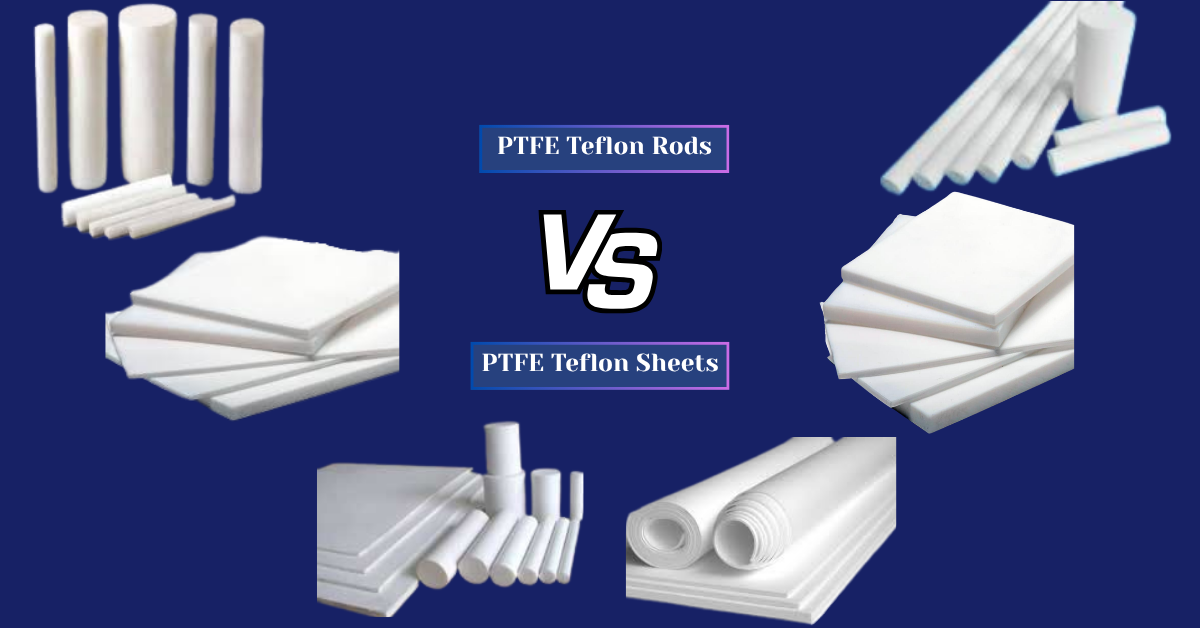
Teflon Sheets vs. Teflon Rods: Which PTFE Form Is Best for Your Application?
When selecting an engineering plastic, many people focus on the material itself. However, choosing the right form of the material is just as important. PTFE, commonly known by the name Teflon®, is available in several forms, with sheets and Teflon rods being two of the most commonly used. Although they are made from the same material and share the same core properties, each form is designed for different applications.
PTFE sheets work well for flat parts like gaskets, liners, wear plates, and insulation panels. PTFE rods are typically machined into round parts like bushings, bearings, rollers, and valve seats. Picking the right form saves machining time, reduces waste and keeps production costs low.
Understanding the differences between PTFE sheets and PTFE rods can help you choose the most suitable material for your project.
Why Is PTFE Used Across So Many Industries?
PTFE is trusted across many industries because it performs well in harsh operating conditions. It resists most chemicals, handles high temperatures, absorbs very little moisture, and has a naturally low-friction surface. It is also an excellent electrical insulator, which makes it beneficial in both mechanical and electrical applications.
These properties make PTFE a common material in chemical processing, food production, pharmaceuticals, electronics, automotive manufacturing, and aerospace. Although the material stays the same, the final product should match the application. That is why understanding the difference between PTFE sheets and PTFE rods is important.
What Are PTFE Sheets Best Used For?
PTFE sheets are ideal for flat components and protective surfaces. Common applications include:
- Gaskets and Seals
Used in pumps, valves, flanges, and pipelines where resistance to chemicals and heat is important.
- Tank and Equipment Linings
Protect tanks, chutes, hoppers, and processing equipment from corrosion and wear.
- Wear Plates and Slide Pads
Provide a low-friction surface that helps reduce wear between moving parts.
- Electrical Insulation
Suitable for insulation panels, barriers, and electrical equipment.
- Food and Pharmaceutical Equipment
Used where cleanliness, chemical resistance, and easy maintenance are required.
PTFE sheets are usually the best option when a flat part requires long-term performance and ease of fabrication.
When Are PTFE Rods the Better Choice?
PTFE rods are used when the finished component needs machining. Typical applications include:
- Bushings and Bearings
Reduce friction and wear in rotating parts.
- Valve Seats
Provide a dependable seal in valves and fluid systems.
- Rollers and Guide Components
Help machines move smoothly with less resistance.
- Custom Machined Parts
Used to produce sleeves, spacers, washers, and precision components.
- Industrial Equipment
Chosen whenever strong cylindrical PTFE parts are required.
If the finished product is round or requires precision machining, PTFE rods are generally the better choice.
Teflon Sheets vs. Teflon Rods: Side-by-Side Comparison
Although PTFE sheets and PTFE rods are made from the same material, they are designed for different applications. The table below highlights the key differences to help you decide which form best suits your project.
| Feature | PTFE Sheets | PTFE Rods |
| Shape | Flat and available in various thicknesses | Solid cylindrical form available in different diameters |
| Best For | Gaskets, seals, liners, wear plates, and insulation | Bushings, bearings, valve seats, rollers, and custom machined parts |
| Machining | Easy to cut, trim, and fabricate into flat components | Ideal for turning, drilling, milling, and precision machining |
| Material Utilization | Efficient for large flat parts with minimal waste | Better suited for machining round or cylindrical components |
| Common Industries | Chemical processing, electrical, food processing, and packaging | Automotive, aerospace, chemical processing, and industrial manufacturing |
| Typical Selection | When a flat surface or protective layer is needed | When a strong, precision-engineered cylindrical part is required |
Both products offer the same core Teflon properties. The main difference is the shape of the finished component and the manufacturing process.
How to Choose the Right Form of Teflon
Ask these questions before making your decision to help you select the right PTFE Form.
Choose Teflon Sheets If You Need:
- Flat components such as gaskets, seals, liners, wear plates, or insulation panels.
- Large surface coverage to protect equipment from chemicals, abrasion, or moisture.
- Custom-cut parts that can be easily fabricated into different shapes.
- An economical solution for applications that do not require large machining.
Choose Teflon Rods If You Need:
- Round or cylindrical parts, like bushings, bearings, rollers, or valve seats.
- Precision-machined parts that need to meet tight measurements.
- Custom parts that need to be turned, drilled, milled, or shaped on a CNC machine.
- Strong, durable parts designed for continuous mechanical use.
Still Not Sure?
If your application starts with a flat design, Teflon sheets are usually the better option. If the final part needs to be machined into a round or precision component, Teflon rods are the more suitable choice.
When in doubt, consider the shape of the finished part first rather than the material itself. Since both products are made from PTFE, their core properties remain the same. The real difference lies in how each form can be manufactured and where it performs best.
Things to Consider Before Buying Teflon Rods or Sheets
Before choosing PTFE sheets or rods, keep these factors in mind to ensure the material meets your application’s requirements.
- Operating conditions, including temperature and chemical exposure.
- Virgin or filled PTFE based on application requirements.
- Correct sheet thickness or rod diameter.
- Machining and fabrication needs.
- Industry standards such as food-grade or high-purity requirements.
Going through these points before ordering helps you select the right PTFE product and avoid unnecessary costs.
Yes. Both are manufactured from PTFE. The difference is the product form and how it is used.
Yes. They can be cut and machined into flat components, while rods are better suited for cylindrical parts.
PTFE rods are generally preferred for round machined components, while PTFE sheets are better for flat fabricated parts.
Consider the operating environment, the finished part shape, the machining process, and the application requirements.
Conclusion
PTFE sheets and PTFE rods come from the same high-performance material, but each one is built for a different job. Sheets work best for flat parts like gaskets, liners, and wear plates, while rods are better suited for precision-machined parts like bushings, bearings, and valve seats. Knowing this difference is really the first step to getting the right material for your project.
That’s why choosing high-quality Teflon material matters just as much as choosing the right form. At Avicos, we offer premium sheets and rods in a range of sizes, designed to meet the demands of industries such as chemical processing, electronics, food processing, and manufacturing. You can check our product description for more detailed specifications on each option.
If you are still not sure whether sheets or rods are right for your application, our team is happy to help you figure it out.