
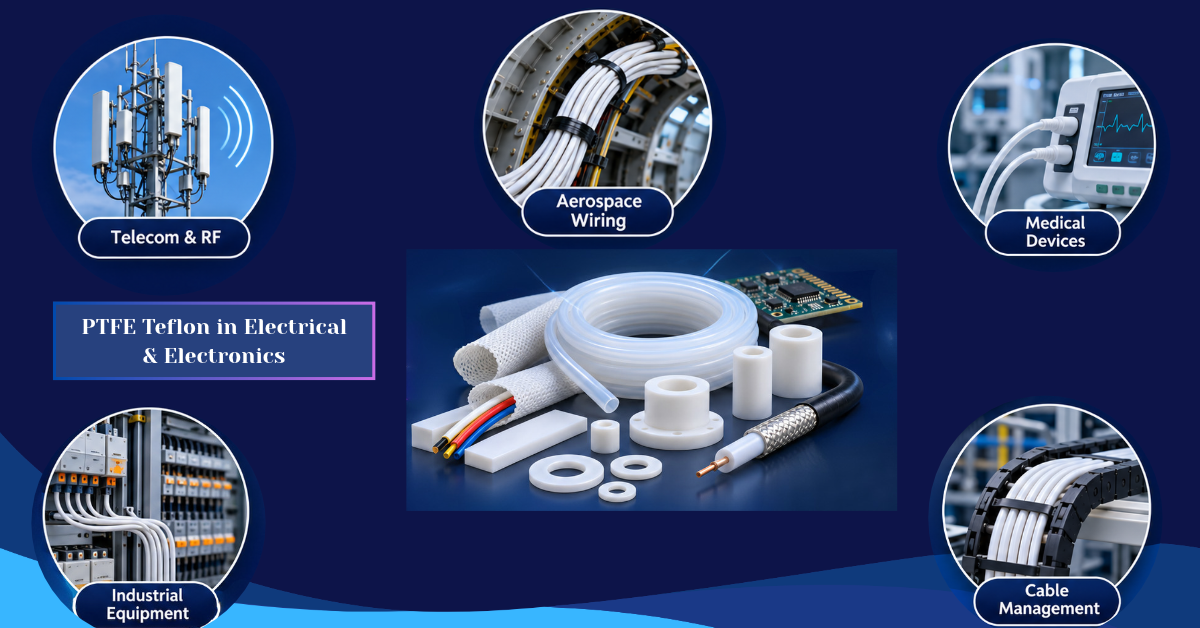
PTFE Teflon in Electrical and Electronics: Insulation, Dielectric Properties, and Cable Management
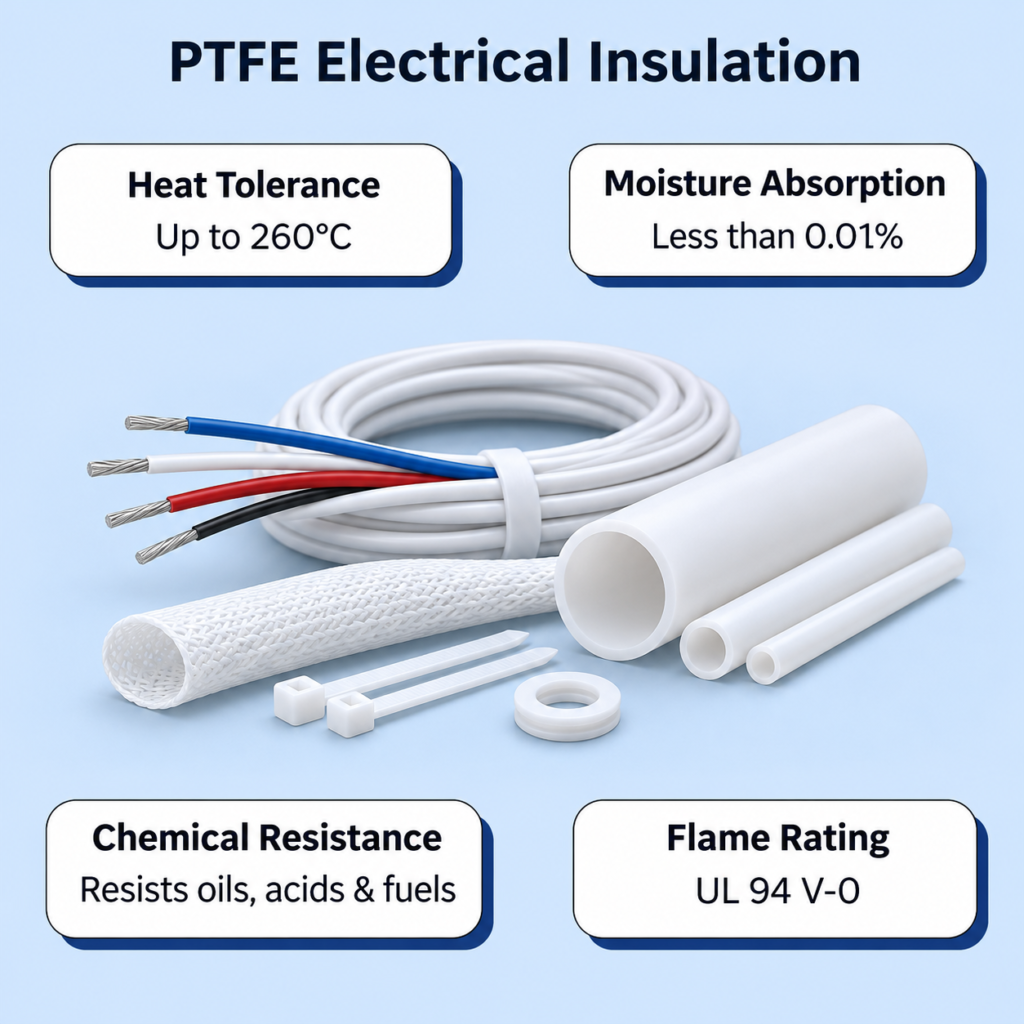
Every wire, cable, and circuit board needs a material that stops electricity from going where it should not. PTFE, also known by the brand name Teflon™, is one of the best materials for this job. It is made of carbon and fluorine, which bond very strongly, making PTFE tough and stable. It can work non-stop at temperatures up to about 260°C; it is not harmed by most chemicals, and it takes in almost no water.
Its dielectric constant is low, at about 2.1, so signals pass through with very little loss. This is why PTFE (Teflon) is widely used in aerospace, telecom, medical, and industrial equipment, where a failure can be very costly. Knowing these qualities will help you pick the right product.
What Makes PTFE Teflon a Reliable Electrical Insulation Material?
PTFE Teflon is a plastic made from carbon and fluorine. The bond between these two elements is very strong, which gives the material a rare mix of strengths. Teflon PTFE resins have a continuous service temperature of 260°C (500°F), which is much higher than common cable plastics. PVC is typically rated at 60–105 °C, so PTFE Teflon can work where PVC would soften or melt.
PTFE also stays stable in oil, fuel, acids, and cleaning agents. It takes in almost no water, so its electrical performance stays steady in damp places. PTFE Teflon absorbs less than 0.01% water over 24 hours.
The main strengths of PTFE Teflon as an insulator are:
- High heat tolerance: Works continuously up to about 260°C.
- Chemical resistance: Is not harmed by most solvents, acids, and fuels.
- Very low moisture absorption: Keeps its insulating ability in humid conditions.
- Fire safety: Unfilled PTFE carries a UL 94 V-0 flame rating.
- Smooth surface: Has a very low friction level, so wires pull easily through tight spaces.
- Long life: Does not age or crack easily in sunlight, weather, or heat.
Understanding the Dielectric Properties of PTFE Teflon
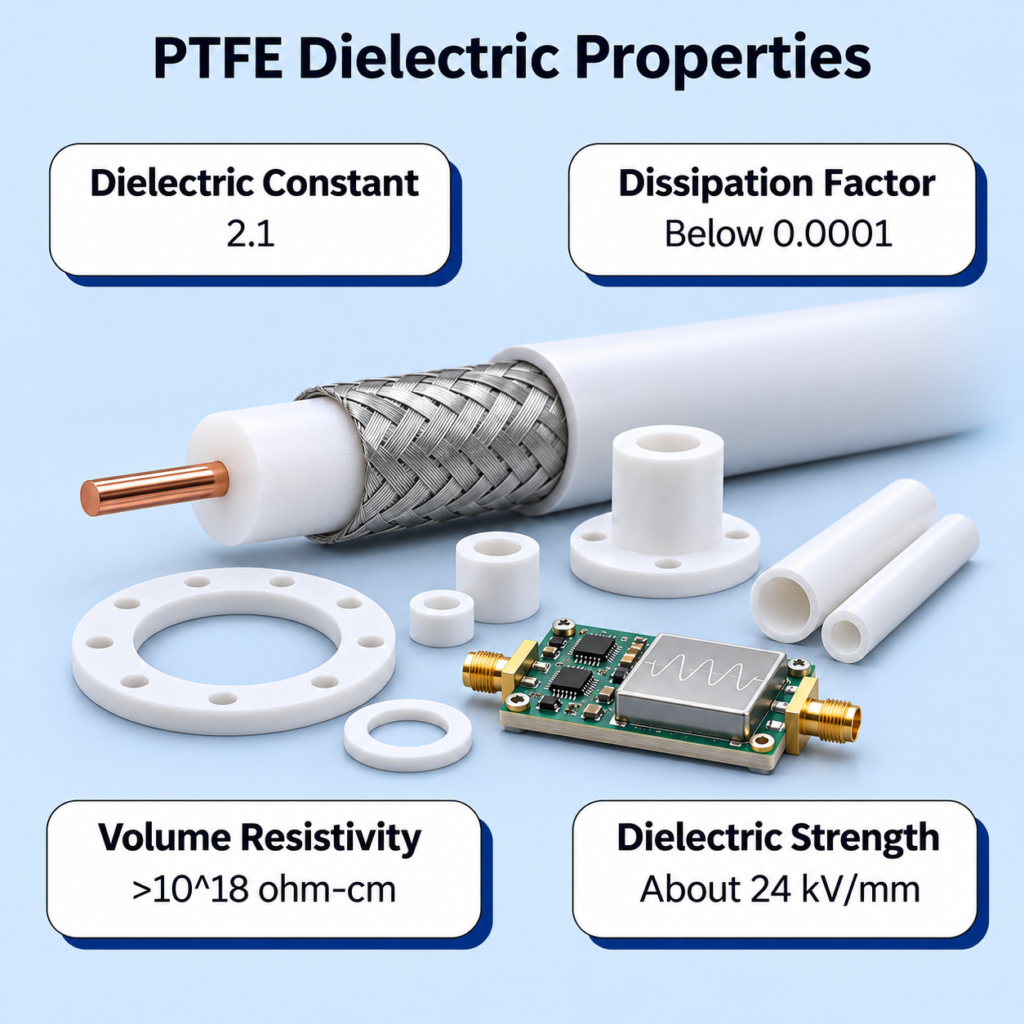
A dielectric is a material that does not conduct electricity. Good dielectric materials block current and lose very little signal energy as heat. PTFE Teflon performs well on all the main measures.
| Property | What it means |
| The dielectric constant at 1 MHz is 2.1. | Signals travel fast with less distortion. |
| The dissipation factor at 1 MHz is below 0.0001. | Very little energy is lost as heat. |
| The volume resistivity is above 10¹⁸ ohm-cm. | Almost no current leaks through. |
| The dielectric strength is about 24 kV/mm. | The material resists breakdown under high voltage. |
| The arc resistance is above 300 seconds. | It does not form a path when sparks occur. |
These values stay almost the same across a wide range of frequencies and temperatures. This is why PTFE is a top choice for high-frequency and radio-frequency (RF) work, where signal quality matters. Dielectric strength varies with thickness and test method, so always check the datasheet for the exact product.
Where Is PTFE Teflon Used in Electrical and Electronic Applications?
PTFE Teflon appears in many industries wherever heat, chemicals, or signal quality are a concern.
Aerospace and defense
Aircraft and defense equipment face high heat and strict safety rules. PTFE is used in wire and cable that meet military standards. It is also used inside aircraft engines and control bays, where space is small and it gets very hot.
Telecom and RF
Radio and telecom systems need strong, clear signals. PTFE is used to insulate coaxial cables for microwave and antenna systems. It is also used in circuit boards that work at high frequencies.
Industrial and automotive
Many machines and vehicles have wires near engines, furnaces, and heaters. PTFE does not soften in this heat, so it is a safe choice. It is also used in sensor wires, thermocouple wire, and 3D printers.
Medical and laboratory
Medical devices must be cleaned and sterilized again and again. PTFE wiring can handle this, so it is used inside these devices. It is also used in the wires of lab test equipment.
Consumer and audio
PTFE is also used in products where sound quality matters. Examples are studio microphone cables, turntable tonearm wire, and high-end audio cables.
Other electrical uses
PTFE is also used to make small electrical parts. These include connector insulators, terminal blocks, spacers, bushings, and washers. It is also used for insulating tape and film in capacitors and coils.
PTFE Teflon in Cable Management: More Than Just Insulation
Good cable management keeps wires safe, tidy, and easy to service. In machines, control panels, and equipment housings, cables often face heat, chemicals, and constant movement. PTFE Teflon helps in these places because it can protect a single wire, organize a whole bundle, and guide cables through tight spaces without wearing out.
PTFE Teflon sleeving and tubing slide over wires and wire bundles to add a second layer of protection. They shield cables from heat, chemicals, and rubbing. Because the surface is so slippery, the sleeves go on easily and do not grab the wire, which makes assembly faster.
Heat-shrink PTFE Teflon tubing is another useful form. When heated, it shrinks tightly around a joint or wire end, giving a clean, sealed finish. Cable ties, clips, and spiral wraps made from fluoropolymers are also used where regular plastic ties would fail in heat.
PTFE Teflon tape is common as well. Engineers wrap it around wire bundles or conductors to add insulation layers in tight or custom designs. Wire can be wrapped with Teflon (PTFE) tape, and this method is used where extruded insulation is not practical.
One practical point about conductors: PTFE Teflon wire normally uses silver-plated copper strands, because the high processing heat would turn standard tin plating black. Nickel-plated copper is also used for the highest temperature ratings.
Limitations of PTFE Teflon in Electrical Use
PTFE (Teflon) performs well in extreme conditions, but it is not the best fit for every project. Cost, mechanical weakness, and processing limits can affect its use in some designs. The points below show where extra care is needed.
- Higher cost: PTFE Teflon cable costs more than PVC because it must meet a much higher temperature rating.
- Poor cut-through resistance: Teflon wire has excellent electrical properties but poor cut-through resistance, so sharp edges or tight clamps can damage it.
- Creep (cold flow): PTFE Teflon can slowly change shape under constant pressure. This matters for parts such as connector insulators that carry a steady load.
- Harder to process: PTFE Teflon does not melt and flow like most plastics. It is shaped by methods such as sintering and paste extrusion, which limits design options.
- Needs special conductors: Silver- or nickel-plated wire is usually required.
- Rules on fluoropolymers: Fluorinated materials are under growing review in some regions. Check the current rules for your market.
FAQs
Teflon is a brand name for Chemours’ fluoropolymer products, and PTFE is the chemical name of the most common one. In daily use, people often treat the two words as the same.
PTFE can work continuously up to about 260°C. A wire’s actual rating also depends on its conductor plating and UL or military approval.
Its dielectric constant is low (about 2.1), and its energy loss is very small. This keeps signals clean and strong, even at microwave frequencies.
It depends on the job. PTFE Teflon performs better in heat, chemicals, and high-frequency use. PVC costs less and is flexible, so it suits general indoor wiring.
Both belong to the Teflon family and have similar electrical values. PTFE Teflon handles higher heat (about 260°C vs. about 200°C), while FEP can be melt-processed more easily, allowing thin, long wire runs.
Yes. Teflon is not damaged by normal soldering operations.
Conclusion
PTFE Teflon is a trusted insulation material for electrical and electronic work. It handles very high heat, resists almost every chemical, takes in almost no water, and keeps signals clean because of its low dielectric constant. It also supports cable management through sleeves, tubes, and tapes that protect wires in tough places. At the same time, its higher cost, poor cut-through resistance, and tendency to creep mean it should be chosen with care. Before buying, check the temperature, voltage, frequency, and chemical needs of your project, and confirm the figures on the supplier’s data sheet.
If you need help finding PTFE Teflon products that suit your application, explore the range at Avicos Plastic. When an application demands steady performance in hard conditions, PTFE Teflon is often the safest and most reliable choice.