
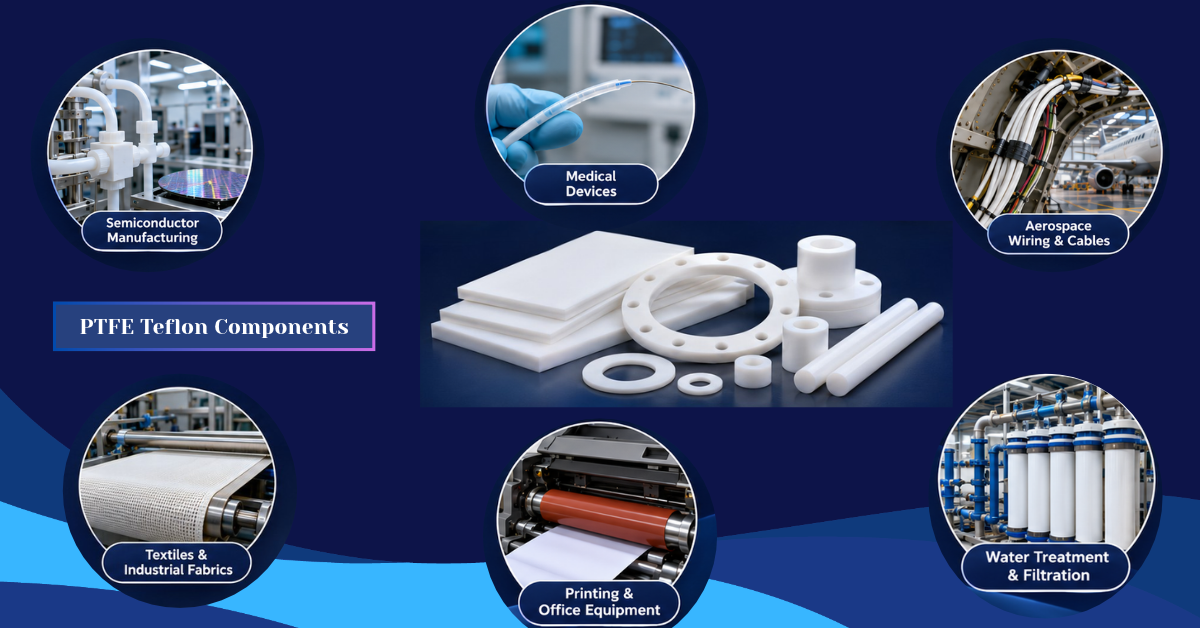
7 Less‑Known Industrial Applications of Teflon Coatings and PTFE Components
PTFE stands for polytetrafluoroethylene; it is a strong plastic that can resist heat, chemicals, and sticking. And Teflon is the most popular brand name for it. Some people think of nonstick pans, but factories use Teflon and PTFE in many other places without even noticing. It also protects equipment and helps parts work smoothly in chip plants, hospitals, aircraft, power stations, and printers.
PTFE can work from about -200°C to 260°C, and manufacturer data describes it as inert to almost all industrial chemicals and solvents. Its surface is also so slippery that very few materials stick to it. Those traits, plus very low friction, explain why it shows up in so many industries. Here are seven of the less obvious ones.
7 Industrial Applications You May Not Know About
Each of these seven uses solves a real problem, such as dirt, friction, heat, or corrosion. The sections below explain the problem first, then show how PTFE Teflon helps.
Semiconductor Manufacturing: Keeping Chemical Handling Equipment Clean
Chip factories clean wafers with strong chemicals that must be very pure, as tiny traces of dirt can harm chips. Fluoropolymers such as PTFE Teflon are widely used in wet benches, tubing, and valves because chemicals hardly affect them. Also, machined PTFE parts can be built in a clean way, which helps avoid metal contamination.
One note: Industry tests found that PFA, a close relative, kept particle counts lower in advanced chip making, so engineers choose between the two.
Medical Devices: Helping Catheters and Guidewires Move Smoothly
Catheters are thin tubes that pass through blood vessels. They need to move smoothly without causing too much friction. PTFE helps make this possible in several ways:
- Catheter Liners: PTFE is used on the inside of catheters to help tubes and balloons pass through easily.
- Guidewire Coatings: Thin Teflon coatings make guidewires smoother, which allows them to move more easily through blood vessels.
- Low Friction: PTFE has a very low friction coefficient of around 0.05 to 0.10, which helps reduce resistance during movement.
- Body-Friendly Material: PTFE is considered biocompatible, which means it can be used in certain medical applications without causing harmful reactions.
- Thin Coatings: PTFE coatings can be applied in very thin layers, sometimes just a few microns thick.
Aerospace: Insulating Wires and Cables in Extreme Conditions
Aircraft wiring faces heat, cold and tight spaces for years. But using PTFE Teflon insulation helps handle all three things and also handles electricity. PTFE and glass insulation are rated from -75°C to 260 °C. It can also appear in heat shrink tubing and protective wraps as it melts at a very high temperature; makers sometimes use PFA or FFP instead to make very long cables.
| Property | Why it helps |
| Heat resistance | Safe near hot engines |
| Chemical resistance | Fuel and oil do no harm |
| Electrical insulation | Signals stay clean |
Power Generation: Protecting Heat Exchangers From Corrosion and Fouling
Power plants release hot flue gas that can turn acidic as it cools, which eats away at metal heat exchangers. Teflon resists corrosion and does not let dirt stick easily. A large waste-to-energy plant in Laogang, near Shanghai, uses Teflon PTFE-based tubes in its gas-to-gas heat exchangers.
Studies of fluoroplastic-steel air preheaters also report strong corrosion resistance and almost no ash build-up. The main disadvantage is cost, so designers often use PTFE only where the gas is harshest.
Printing and Office Equipment: Helping Rollers Release Paper and Ink
Printers and copiers press hot rollers against paper to fix toner.
- Roller coatings: Fuser rollers use Teflon (PTFE) or silicone rubber so toner does not stick.
- Fuser belts: Some belts have a top coat of PTFE or PFA.
- Release wicks: Porous PTFE spreads a thin layer of release oil.
- Trade-off: Patents note PTFE is hard and not very flexible, so it is often combined with other layers.
Water Treatment and Filtration: Supporting Fluid Separation
Teflon repels water and handles heat, which fits the thin membranes used to separate clean water from dirty water. In membrane distillation, warm wastewater gives off vapor that passes through a PTFE membrane while the liquid stays behind. Some manufacturers also treat PTFE to make it more hydrophilic, allowing it to work in standard filtration modules. Some studies show PVDF can pass more water in certain setups, so PTFE is one choice among several.
| Use | PTFE’s role |
| Membrane distillation | Blocks liquid, passes vapor |
| Filtration modules | Treated surface lets water through |
Textiles and Industrial Fabrics: Preventing Sticking and Resisting Heat and Chemicals
Teflon-coated fiberglass fabric is used wherever materials must not stick and must handle heat.
- Conveyor belts: Carry items through dryers and ovens, including textile drying lines.
- Heat sealing: Belts and sheets press packaging films without sticking.
- Apparel and carpets: Suppliers list fuse pressing belts for clothing and carpet production.
- Wear limit: The coating can lift from the glass fabric over time.
PTFE Coatings or Solid PTFE Components: Which Is the Better Choice?
A Teflon coating adds PTFE’s slippery surface to another material, such as metal or fabric. A solid component is made entirely of PTFE, like a seal or tube. Solid PTFE is not very strong, so makers add fillers such as glass fiber or carbon when needed.
| Factor | Coating | Solid PTFE |
| Best for | Rollers, fabrics, tools | Seals, tubes, liners |
| Strength | From the base material | Lower, helped by fillers |
| Wear | May wear off | Wears through full thickness |
| Chemical contact | Needs no tiny holes | PTFE throughout |
As a simple rule, pick a coating when only the surface needs help, and pick a solid part when the whole component must resist chemicals or heat.
FAQs
Most sources list about 260°C (500°F) for regular use.
Yes. Manufacturer data calls it inert to nearly all industrial chemicals and solvents, which is why it is used in chip plants and chemical equipment.
Yes. Solid PTFE is not very strong, and coatings can wear off or lift in tough conditions. Choosing the right grade and design helps avoid these problems.
Select a coating only when the surface requires help. Choose a solid part when the whole component faces chemical exposure or heat. Share your conditions with a supplier to select the right coating for your use.
Conclusion
One of the most difficult jobs in industry is performed by a material most people never notice. PTFE Teflon keeps chip-making chemicals clean, helps catheters flow, protects aircraft wiring, guards power plant equipment, supports water treatment and makes fabrics nonstick. Choosing between a coating and a solid part, and selecting the right grade, determines performance.
If your project includes heat, chemicals, or moving parts, PTFE Teflon is worth having a look. It helps save time, cut wear and helps keep equipment moving smoothly. At Avicos Plastic, we supply PTFE Teflon components across the UAE and the wider Middle East. If you need help choosing the right size or type for your needs, our team is here to help you figure it out. Get in touch today for a quote or expert advice.