
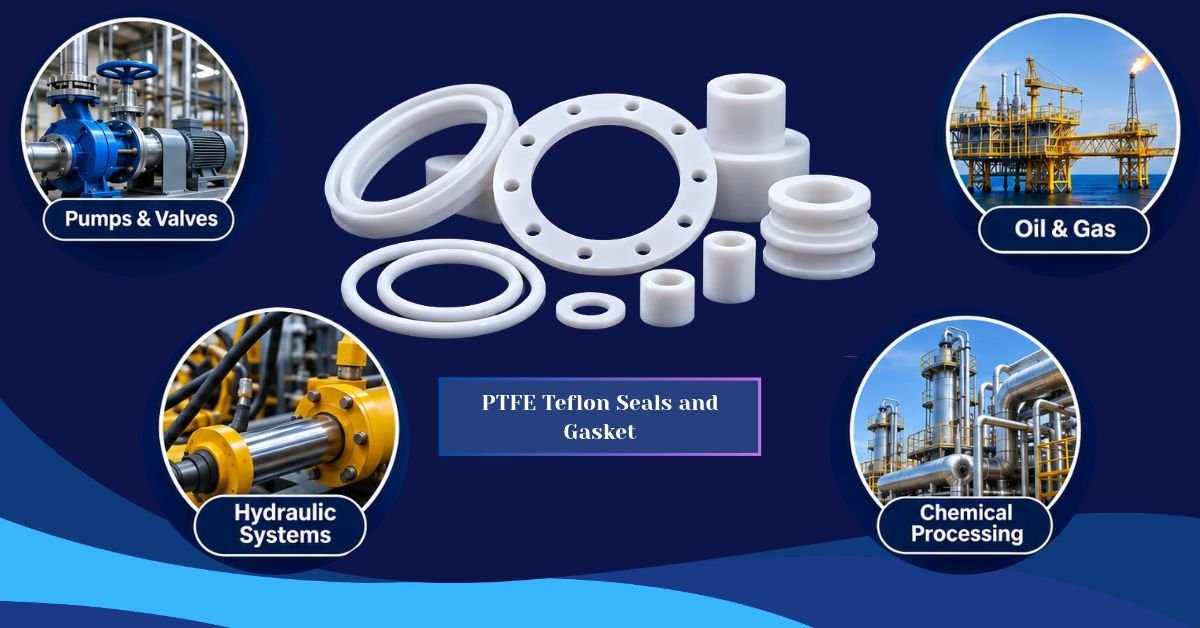
PTFE Teflon Seals and Gaskets for High-Pressure Industrial Applications
PTFE Teflon seals and gaskets help avoid leaks and keep industrial equipment working properly. However, in high-pressure systems, they face pressure changes, heat, friction, and chemicals. Eventually, these conditions can cause the seals to wear out, lose their shape, or fail to prevent leaks. This can result in fluid leakage, equipment damage, and unexpected maintenance costs.
Polytetrafluoroethylene, commonly known as Teflon, is widely used in industrial sealing applications because of its chemical resistance, low friction, and ability to withstand a wide range of temperatures. When selected and installed correctly, PTFE Teflon seals and gaskets can help reduce wear and extend the service life of high-pressure equipment.
How PTFE Teflon Helps Seals and Gaskets Last Longer in Industrial Equipment
Industrial machine seals and gaskets are always under pressure. Over time, this pressure deforms the material. They can also be sandwiched between two metal surfaces. This makes the seal more difficult to function. Heat, friction, and chemical damage worsen.
Given below are some of the common problems that PTFE Teflon seals and gaskets face.
- High pressure can cause a seal or gasket to lose its original shape. This may create small gaps through which fluids or gases can escape.
- Seals in moving parts can slowly wear down because of constant rubbing.
- Some materials may slowly lose their shape when kept under pressure for a long time. This can make it harder for them to fit tightly between two surfaces.
- Some chemicals can damage sealing materials and weaken them.
- Damaged seals may not be able to stop fluids or gases from passing through, causing leaks.
A damaged seal can cause problems for the entire machine. Fluids may leak, parts may need repair, and the equipment may have to be stopped until the seal is replaced.
Why PTFE Teflon Works Well in Tough Conditions?
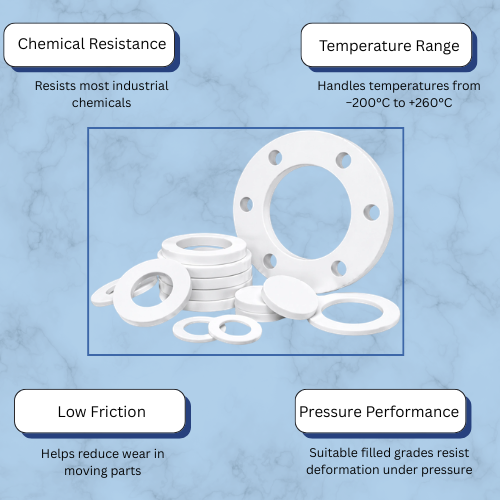
Factory seals face heat and pressure, as well as varying temperatures and chemicals. PTFE Teflon can endure most of these conditions. It is helpful in machines that carry different liquids. Its smooth surface is another reason it is widely used. It does have some friction, so parts can easily move against the machine. This removes friction from them and reduces the amount of wear over time.
The next thing to consider is temperature. They also are not always the same machines, temperature-wise. Some operate at cold temps; some at dangerously high temps. PTFE Teflon alone is up for both, which is why it is a favorite for many industrial applications.
However, regular Teflon has one limitation. Under long-term pressure, it slowly deforms. To overcome this, manufacturers add carbon or glass fiber to PTFE. This is called filled PTFE Teflon. It resists compression and is usually used for better seals.
Various Types of PTFE Teflon Seals
Plain PTFE Teflon is clean and very slippery, but also soft. In its pure form, PTFE is weak and tends to creep under load, which is a problem in a high-pressure line. Manufacturers overcome this by mixing it with glass, carbon, graphite or bronze.
Each filler changes the behavior of the seal; therefore, two PTFE Teflon seals can behave quite differently, even in the same machine.
| Type | What is in it | Where it works best | Watch out for |
| Virgin PTFE Teflon | Pure PTFE, no fillers | Food, medical and other high-purity jobs. | Creeps under heavy load. |
| Glass-filled PTFE Teflon | PTFE with glass fibers | Higher-pressure jobs where the seal should hold its shape. | Rougher on mating surfaces than carbon-filled grades. |
| Carbon-filled PTFE Teflon | PTFE with carbon or graphite | Piston rings and dynamic seals. | Handles harsh chemicals better than glass. |
| Bronze-filled PTFE Teflon | PTFE with bronze powder | Heavy loads, such as hydraulic seals. | Less chemical resistance than virgin PTFE. |
A simple way to choose is to start with the fluid, then look at the pressure, and then check whether the parts move.
PTFE Teflon Seals vs. Traditional Sealing Materials: Which Performs Better?
PTFE is a good sealing material, but it is not the only option. Nitrile (NBR), EPDM and Viton (FKM) are also used in industrial equipment. Each material has its own uses. Check out the simple comparison to help you understand the differences.
| Feature | Teflon (PTFE) | Nitrile (NBR) | EPDM | Viton (FKM) |
| Temperature range | -200°C to +260°C | Around -30°C to +100°C | Around -50°C to +150°C | Around -20°C to +200°C |
| Chemical resistance | Resistant to most industrial chemicals | Good with oils and fuels | Good with water, steam and ozone | Good with oils and many hydrocarbons |
| Friction | Very low | Higher | Higher | Higher |
| Flexibility | Rigid and less flexible | Flexible | Flexible | Flexible |
| Cost | Generally higher | Generally lower | Generally lower | Medium to high |
Note: These temperature ranges are approximate. Actual limits depend on the material grade and working conditions.
When do PTFE Teflon Seals and Gaskets Provide Long-Term Performance?
PTFE Teflon is used in industries where a leak means lost product, damaged equipment or a safety hazard. These are the areas that pay off the most
- PTFE Teflon seals and gaskets are used in pumps, valves and process equipment exposed to strong acids and solvents.
- PTFE is frequently used on valves in the pharmaceutical and food industries due to its cleanliness and safety. Virgin grades are suitable for high-purity work.
- Growing investment in petrochemicals and oil and gas across the Middle East is driving demand for PTFE.
- Bronze-filled PTFE is used in hydraulic seals subject to heavy loads; carbon-filled grades are used in piston and compressor rings.
- PTFE Teflon ensures leak-free connections with corrosive fluids and in high-pressure, high-temperature lines where rubber may fail.
- Teflon is used in car gaskets, seals and bushings, and in medical tubes, catheters and pumps. Teflon is also used in car gaskets, seals, and bushings, and in medical tubes, catheters, and pumps.
What Should You Consider Before Choosing PTFE Teflon Seals and Gaskets?
The Teflon/PTFE seal is only as good as it is if it’s the proper seal for the system. Begin with fluid and temperature. Be aware of the hottest and coldest parts of your system and the contact of your seal. Virgin PTFE Teflon is good from -200°C to +260°C, but filled grades have different temperature limits depending on the filler.
Fillers change chemical resistance as well: filled grades give up some chemical resistance for better strength. That’s why the grade should be dictated by the fluid.
Then there is movement and pressure. Virgin PTFE Teflon will creep, forcing almost constant or heavy pressure to use a filled grade glass-filled or bronze-filled Teflon to bring the strength in high-pressure, high-work jobs.
Bronze- or carbon-filled grades are better for rotating or sliding surfaces that will rub against the seal. Don’t forget the fit, either. PTFE Teflon is hard to fit into the grooves used for rubber O-rings, so check the groove size and shape.
Finally, consider approvals and costs. If for food or pharmaceutical use, make sure the grade you purchase has the required approval. PTFE Teflon is usually more expensive than rubber, so weigh the cost against the seal life and how often you would have to shut down to replace it. If you have any inquiries, tell your supplier your temperature, pressure and fluid info before you order.
FAQs
The most common cause is that regular PTFE Teflon will slowly creep under load. Virgin PTFE is not very strong, and it can creep. Unlike rubber, it does not spring back, and so small gaps can develop over time. A filled grade or spring-energized design will usually solve the problem.
Begin with the job. Glass or carbon fillers are good for high wear and high load. Bronze or carbon fillers help to conduct heat away. Chemicals are important too because carbon is more resistant to harsh chemicals than glass, and bronze-filled grades are less resistant to chemicals than virgin PTFE.
Not all the time. PTFE may be harder to install in grooves that are designed for rubber O-rings. Verify the groove dimensions and shape with your supplier and ask if a spring-energized seal would be a better fit for the groove.
Depending on the filler, it can. Compounds with a carbon filler are less abrasive than those with a glass filler. For rotating or sliding parts, check with your supplier the surface finish and hardness the grade requires.
Conclusion
PTFE Teflon seals and gaskets can help high-pressure equipment last longer when you choose the right type. Regular PTFE Teflon handles heat, chemicals and friction well. However, it can slowly lose its shape under constant pressure. To make it stronger, manufacturers add materials such as glass, carbon or bronze. Before choosing a seal, check the temperature, pressure, type of fluid and movement of the machine.
The right seal can help avoid leaks, reduce repairs and keep equipment running for a long time without interruptions. If you need help choosing the right PTFE Teflon grade, contact Avicos Middle East Plastic Trading LLC.