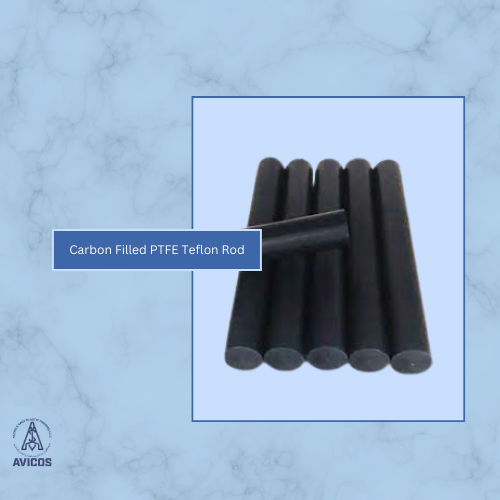
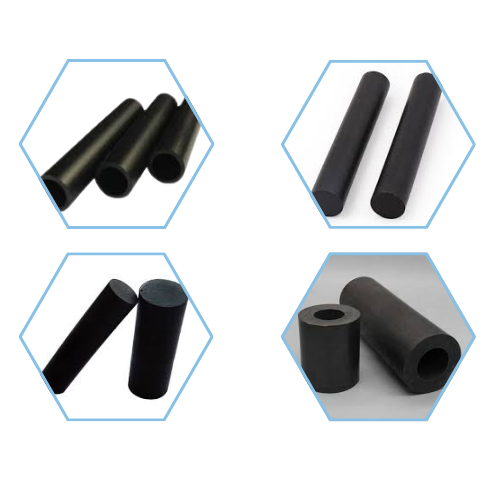
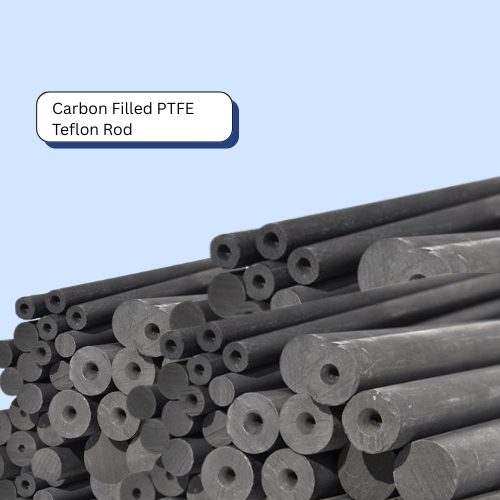
What is Carbon Filled PTFE Teflon Rod?
Carbon-filled PTFE Teflon Rod is a high-performance composite material created by infusing polytetrafluoroethylene (PTFE) with carbon particles or fibers. This enhancement significantly improves the mechanical strength, wear resistance, and thermal conductivity of standard PTFE, making it suitable for demanding industrial applications. Unlike pure PTFE, which tends to deform under heavy loads due to low mechanical strength, carbon-filled variants exhibit reduced creep, better dimensional stability, and increased load-bearing capacity. The carbon additive also imparts partial electrical conductivity, making these rods ideal for anti-static and electrical dissipation applications.
Additionally, the material retains PTFE’s signature chemical inertness, providing excellent resistance to acids, alkalis, and solvents. Carbon-filled PTFE rods are commonly used in dynamic seals, bearings, valve components, and other applications that require low friction, enhanced durability, and effective thermal management. Their ease of machining, combined with superior performance, makes them a preferred choice in aerospace, automotive, chemical processing, and electrical industries. Overall, Carbon Filled PTFE Teflon Rod delivers a balanced blend of strength, wear resistance, and chemical stability essential for high-demand environments.
What are the Features of carbon-filled PTFE Teflon Rod?
These features collectively make Carbon Filled PTFE Teflon Rod a versatile and reliable material for industries demanding enhanced mechanical strength, wear resistance, and thermal management.
- Enhanced Mechanical Strength: The carbon filler significantly improves the rod’s load-bearing capacity and reduces deformation under stress, making it ideal for high-pressure and dynamic applications.
- Improved Wear Resistance: Carbon-filled PTFE exhibits superior abrasion resistance compared to pure PTFE, thereby extending the life of components in moving parts, such as seals and bearings.
- Low Friction Coefficient: The material maintains PTFE’s low friction surface, reducing wear and energy consumption in mechanical systems.
- Better Thermal Conductivity: Carbon fillers boost heat dissipation, preventing overheating in components exposed to high temperatures.
- Excellent Chemical Resistance: The rod retains PTFE’s inertness and resistance to a wide spectrum of corrosive chemicals and solvents.
- Partial Electrical Conductivity: Unlike pure PTFE, carbon-filled variants provide anti-static properties, useful in electrical and electronic applications.
- Dimensional Stability: Carbon reduces creep and cold flow, ensuring the rod keeps its shape and performance over time.
- Easy Machining: The composite is machinable with standard tools, allowing precision fabrication with minimal tool wear.
Applications
Carbon-filled PTFE Teflon rods find extensive applications across various high-demand industries due to their unique combination of chemical resistance, mechanical strength, and thermal stability. It is widely used in the aerospace and automotive sectors for manufacturing seals, bearings, piston rings, and bushings, where durability under pressure and temperature extremes is crucial.
The rod’s enhanced wear resistance and low friction make it suitable for dynamic seal applications, providing longevity and reliability in hydraulic and pneumatic systems. Its dimensional stability and creep resistance allow it to maintain performance in critical machinery components subjected to constant stress and movement.
Additionally, carbon-filled PTFE rods are favored in the electrical and electronics industries for producing insulating components with anti-static properties, due to their partial electrical conductivity. The chemical processing industry also benefits from these rods in making parts that are exposed to harsh chemicals, ensuring an extended service life and safety.
Furthermore, their ease of machining enables the production of precision custom parts in various industrial sectors, including food processing, medical devices, and chemical manufacturing. The rods effectively address diverse operational challenges, making them versatile and indispensable for applications that require reliable performance in extreme environments. Their balance of strength, thermal management, and chemical inertness secures their place as a high-performance choice for demanding industrial needs.
How to Use?
Proper handling and installation techniques are crucial for maximizing the performance and lifespan of Carbon-Filled PTFE Teflon Rods in various applications.
- Select a suitable diameter, length, and wall thickness
- Machine according to specifications for accuracy
- Install in high-pressure or high-temperature systems
- Maintain within specified temperature and chemical compatibility
- Store in dry, cool environments away from UV exposure
Safety Guidelines
Ensuring the safe operation and handling of Carbon-Filled PTFE Teflon Rods involves following recommended precautions to protect personnel and maintain product integrity.
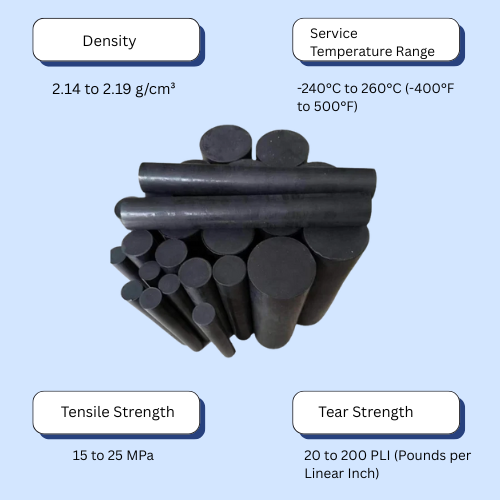
- Operate below maximum temperature limits (260°C)
- Wear protective gear during machining and handling
- Ensure adequate ventilation during fabrication or heating
- Avoid open flames and excessive heat sources
- Dispose of waste materials safely, following regulations